
Touch Panel
Touch panels are a common and innovative interface technology in today's society, allowing users to interact with their devices by simply touching the screen. Undoubtedly, touch panels have improved the way we interact with a variety of devices, including cell phones, computers, ATMs, and more. Unlike traditional input methods, touch panels provide a more direct and intuitive way to operate a device, bringing a very convenient design and experience to the community. Whether it's responsive tactile feedback or more avant-garde design, the simplicity and efficiency of touch panels have made them universally popular in the community. A touch panel The following is a description of the types and advantages of touch panels.
What is touch panel?
A touch panel or touch screen panel is an input device that commonly placed in front of the display screens of instruments which require human interface. A touch panel operates by detecting the user's touch and translating it into commands, using either resistive, capacitive, or other sensing technologies to register input on the screen. The touch screen panels are often used to enhance or supplement the more traditional input technologies such as membrane or silicone-rubber keypads. And because of the intuitive nature of touch screens, this method has been gaining popularity over the years.
Types of Touch Panels
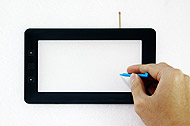 Resistive Touch Screen Panels: Structure and how they work.
The resistive touchscreen is the touchscreen panels that composed of two layer of PET film coated with resistive material and separated by a thin air gap. This kind of touchscreens are versatile as they can be operated with a finger, a stylus and any other object.
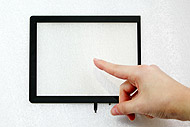 Capacitive Touch Screen Panels: Advantages and common uses.
The capacitive touchscreen panels sense the touch by detecting slightly electronic field change of the screen caused by the conductive property of finger. This type of touch screen could only be operated with finger or specific styli.
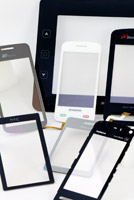 Touch Lens
Touch lens is essentially a redesign of the traditional resistive touch screen technology. As more and more devices are designed to feature increasingly flat touch modules, a diverse range of applications are also emerging to compliment this technology, thus making touch lens design a popular choice.
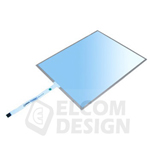 Touch Screen Panel Photo Gallery
Advantages of Touch Panel Technology
Touch panel technology offers numerous benefits that have significantly enhanced user interaction with digital devices.
Convenience
Touch panel's intuitive interface allows users of all ages and skill levels to operate devices with ease, making technology more accessible. The direct interaction facilitated by touch panels eliminates the need for additional input devices like keyboards or mice, streamlining user experience and saving space. High efficiency
Touch panels support multi-touch gestures, enabling more complex and efficient commands, which is particularly beneficial in creative and professional applications. Their durability and resistance to dirt and liquids make them ideal for public use in ATMs, kiosks, and medical equipment.Aesthetic
The sleek and modern design of touch panels contributes to the aesthetic appeal of devices, aligning with contemporary design trends.
Usage of Touch Panel
Touch panels are often used as an alternative or supplement to more traditional human machine interface technologies such as a membrane switch or a silicone keyboard. The use of a touch panel allows the keypad to be reconfigured as desired to suit the application. Because of their intuitive nature, touch panels are often used in applications so that users do not require extensive training to interface with devices such as kiosks and point of sale machines.
Reliable touch panel supplier - Elcom Design
Elcom manufactures resistive touch panels(touch screens), capacitive touch screens and touch lences, all these products can be comstomized in size and functions like waterproof and multi-touch points.
Elcom, as a reliabel touch screen supplier, promises our client that the touch panels were designed and manufactured to meet the highest level of standards, so customers are assured of reliable quality and consistent assembly schedules all the time.
Specification of Touch Screen Panel
| Category | Attribute | Specification | |
| Electrical | Maximum Circuit Rating | 5V DC, 35mA | |
| Insulation Resistance | Matrix 20MΩ or more at 50V DC; Analog 20MΩ or more at 25V DC | ||
| Dielectric Withstand | 250V Rms (50-60Hz 1min) | ||
| Contact Bounce | 30ms or less | ||
| Mechanical | Actuation Force | 10g to 100g | |
| Linearity | 1.5% or less | ||
| Life Expectancy | 35,000,000 touches | ||
| Surface Hardness | 3H or more | ||
| Glass Thickness | 0.7mm, 1.1mm, 2.0mm, 3.0mm | ||
| Environmental | Operation Temperature | -10°C to +60°C | |
| Storage Temperature | -20°C to +70°C | ||
| Humidity | 40°C, 90% to 95% for 240 hours | ||
| Optical | Transparency | ≥80% ± 2% | |
| Structure | Structure | Film to Glass |
